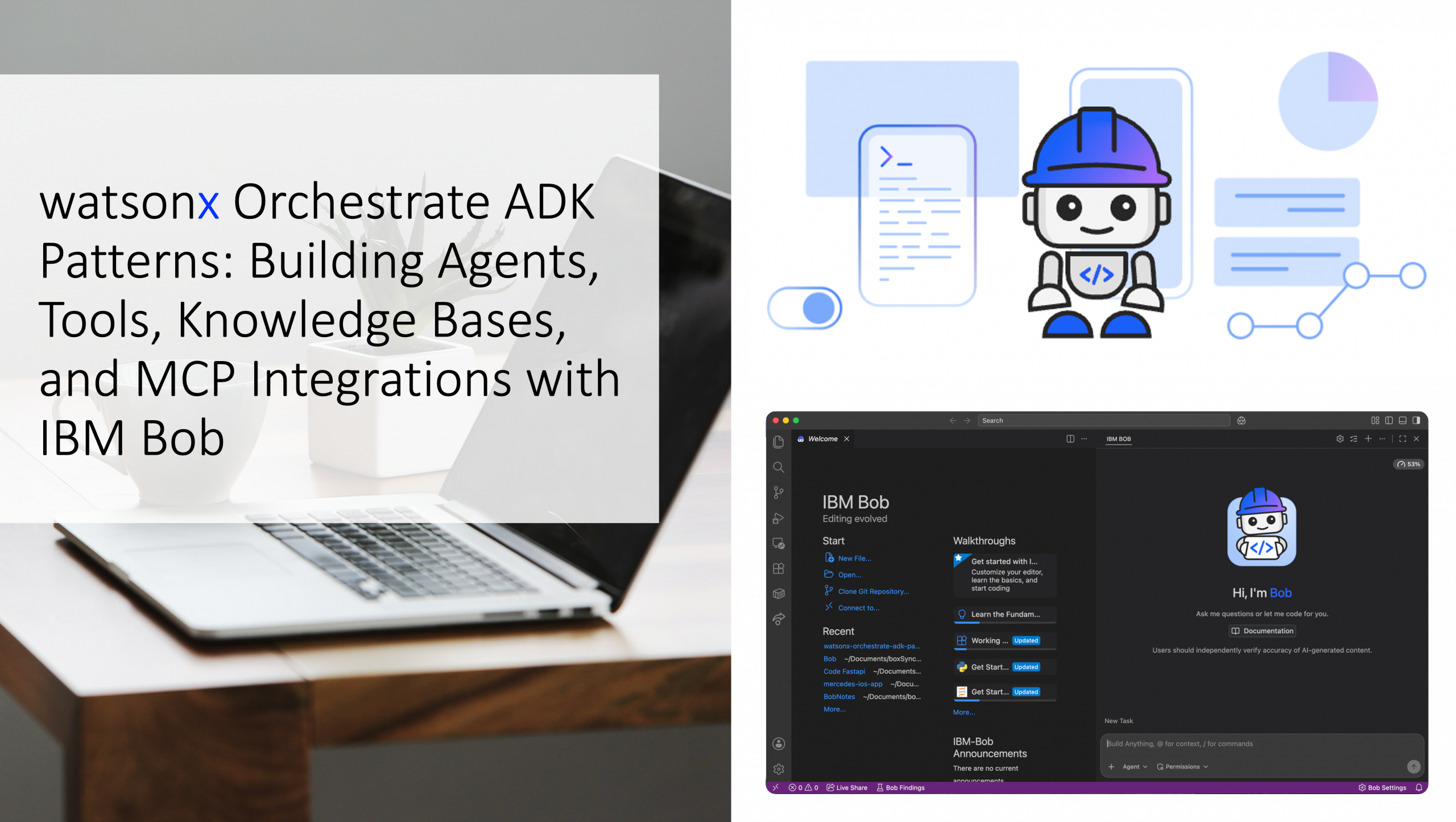
The future of software development is agentic. Instead of writing isolated scripts, developers are now assembling intelligent systems that combine large language models, tools, retrieval-augmented generation (RAG), external APIs, and distributed agent collaboration. IBM’s watsonx Orchestrate Agent Developer Kit (ADK) provides the foundation for building these systems, while IBM Bob takes productivity to an entirely new level by helping developers design, generate, deploy, and maintain them.
To help developers get started, I created watsonx Orchestrate ADK Patterns, a GitHub repository containing practical examples, templates, and reference architectures for building enterprise-grade AI agents with watsonx Orchestrate.
GitHub Repository: watsonx Orchestrate ADK Patterns
Why This Repository?
When developers first explore watsonx Orchestrate, they quickly encounter multiple building blocks:
- Agents
- Tools
- Knowledge Bases
- Connections
- MCP Toolkits
- Prompt Templates
- Multi-Agent Architectures
While the platform is incredibly flexible, it can be difficult to know where to start.
The goal of this repository is simple: provide reusable patterns that demonstrate how these components work together in real-world solutions.
Rather than starting from a blank page, developers can leverage production-inspired examples and adapt them to customer use cases, internal applications, automation projects, or enterprise integrations.
The repository is structured around the core building blocks of the watsonx Orchestrate ADK:
watsonx-orchestrate-adk-patterns/
├── agents/               # Agent definition YAML files
├── tools/                # Python tool implementations
├── knowledge_bases/      # Knowledge base definitions and source documents
├── connections/          # Connection definition YAML files
├── prompts/              # IBM Bob prompt templates
└── README.md
Each folder focuses on a specific aspect of agent development and provides starter templates that can be immediately deployed and extended.
Meet IBM Bob – Your AI-Powered Development Partner
One of the most exciting aspects of modern AI development is that developers are no longer coding alone.
IBM Bob acts as an AI-powered development partner that works directly within your development workflow, helping you design, build, test, modernize, and maintain software.
Try IBM Bob: IBM Bob
Unlike traditional code assistants that focus solely on code completion, Bob is designed as an agentic development environment. It can understand entire repositories, orchestrate specialized agents, automate development tasks, and accelerate work across the complete Software Development Lifecycle (SDLC).
Build with Agents
Perhaps the most impressive capability of Bob is its ability to spawn specialized agents and subagents.
Instead of forcing a single AI model to handle every task, Bob can create focused agents with their own tools, context, and responsibilities. These agents can work in parallel on different parts of a problem and return only the important results.
This aligns perfectly with the architecture patterns used in watsonx Orchestrate itself. As developers build multi-agent solutions in ADK, they can use Bob to help design, generate, and maintain those agents faster.
Literate Coding: Develop in Natural Language
One of my favorite Bob capabilities is Literate Coding.
Rather than switching between documentation, chat windows, and your IDE, you can explain your desired outcome in plain English (or your preferred language), and Bob generates the implementation directly within the context of your codebase.
This is especially powerful when working with watsonx Orchestrate patterns.
Instead of manually creating an agent YAML, a knowledge base configuration, and supporting tools, you can simply describe what you want and let Bob generate the required artifacts.
For example:
“Create a customer support agent that can answer questions about car manuals using a knowledge base and provide escalation options to a service center.”
Bob can help generate much of the initial implementation while following the conventions defined in the repository.
AI Beyond the IDE
Bob is not limited to your editor.
With Bob Shell, the same agentic capabilities can be used directly from the terminal, supporting:
- Interactive development
- Automation scripts
- Build pipelines
- CI/CD workflows
- Development operations
This enables teams to bring AI-driven automation into every stage of software delivery.
Bobalytics: Understanding AI Impact
As organizations adopt AI-assisted development at scale, measuring impact becomes increasingly important.
Bob includes Bobalytics, a platform for tracking how AI agents contribute across the development lifecycle.
Teams can understand:
- Development acceleration
- Agent contribution metrics
- AI adoption trends
- Cost optimization opportunities
- Governance and compliance visibility
This helps move AI from an experimental tool to a measurable enterprise capability.
Building Agents with the ADK
At the core of the repository are agent definition templates.
Agents in watsonx Orchestrate are defined through YAML files using the ADK specification. These definitions control everything from the selected language model to available tools, collaborators, memory settings, and retrieval capabilities.
The repository provides examples demonstrating:
- Single-agent architectures
- Multi-agent delegation patterns
- Memory-enabled agents
- Knowledge-aware agents
- Scheduled agents
- Tool-enabled agents
These examples serve as blueprints for common enterprise scenarios.
Tools: Giving Agents Superpowers
Agents become truly useful when they can take action.
The repository includes example tools demonstrating common development patterns:
- User interaction tools
- Calculators
- REST API integrations
- Database access
- Data transformation pipelines
Every example follows ADK best practices and highlights one often-overlooked concept:
Tool docstrings matter.
The description provided in a tool’s Python docstring becomes part of the agent’s decision-making process. In many cases, a well-written docstring can dramatically improve the quality of tool selection and orchestration.
Secure Integrations with Connections
Enterprise applications require secure access to external systems.
The repository demonstrates how to configure reusable connections for:
- API Keys
- OAuth2
- Bearer Tokens
- Basic Authentication
- Public APIs
Instead of embedding credentials in source code, developers can rely on managed connections and the watsonx Orchestrate secrets framework.
This results in cleaner implementations, improved security, and easier governance.
Bringing Enterprise Knowledge to Agents
Most enterprise AI solutions require access to proprietary information.
The knowledge_bases section demonstrates how to implement Retrieval-Augmented Generation (RAG) using:
- PDF files
- DOCX documents
- Text content
- Website ingestion
- IBM Watson Discovery collections
By attaching knowledge bases directly to agents, developers can build assistants that provide grounded responses using enterprise-specific information rather than relying solely on foundation model knowledge.
MCP: Connecting to the Enterprise Ecosystem
One of the newest and most exciting capabilities supported by the repository is Model Context Protocol (MCP) integration.
MCP enables watsonx Orchestrate agents to securely interact with external tools and services running outside the platform.
The included patterns demonstrate:
- Remote MCP Toolkit registration
- YAML-based toolkit definitions
- Authentication patterns
- Deployment workflows
- CI/CD integration
Whether connecting to cloud platforms, third-party APIs, or internal services, MCP opens the door to an entire ecosystem of reusable capabilities.
The repository even includes examples using publicly available services such as CoinGecko to illustrate real-world usage.
IBM Bob + watsonx Orchestrate ADK = A Powerful Combination
What makes this repository particularly powerful is its synergy with IBM Bob.
The repository doesn’t just contain agents, tools, and templates—it also includes Bob prompt templates that accelerate development even further.
Developers can copy a prompt, open Bob, and let it help generate complete implementations based on proven patterns.
In many ways, the repository becomes a library of reusable building blocks, while Bob becomes the AI engineer that assembles them.
This combination dramatically lowers the barrier to entry for agentic development and helps teams move from idea to implementation significantly faster.
Get Started Today
If you’re interested in building enterprise AI agents, multi-agent systems, MCP integrations, or RAG-powered assistants, this repository is designed to give you a practical starting point.
Explore the repository: watsonx Orchestrate ADK Patterns
Learn more about IBM Bob: IBM Bob – Your AI-Powered Development Partner
Agentic development is rapidly becoming the new standard for enterprise software. With watsonx Orchestrate ADK providing the foundation and IBM Bob acting as your AI-powered engineering partner, developers can focus less on boilerplate and more on delivering real business value.