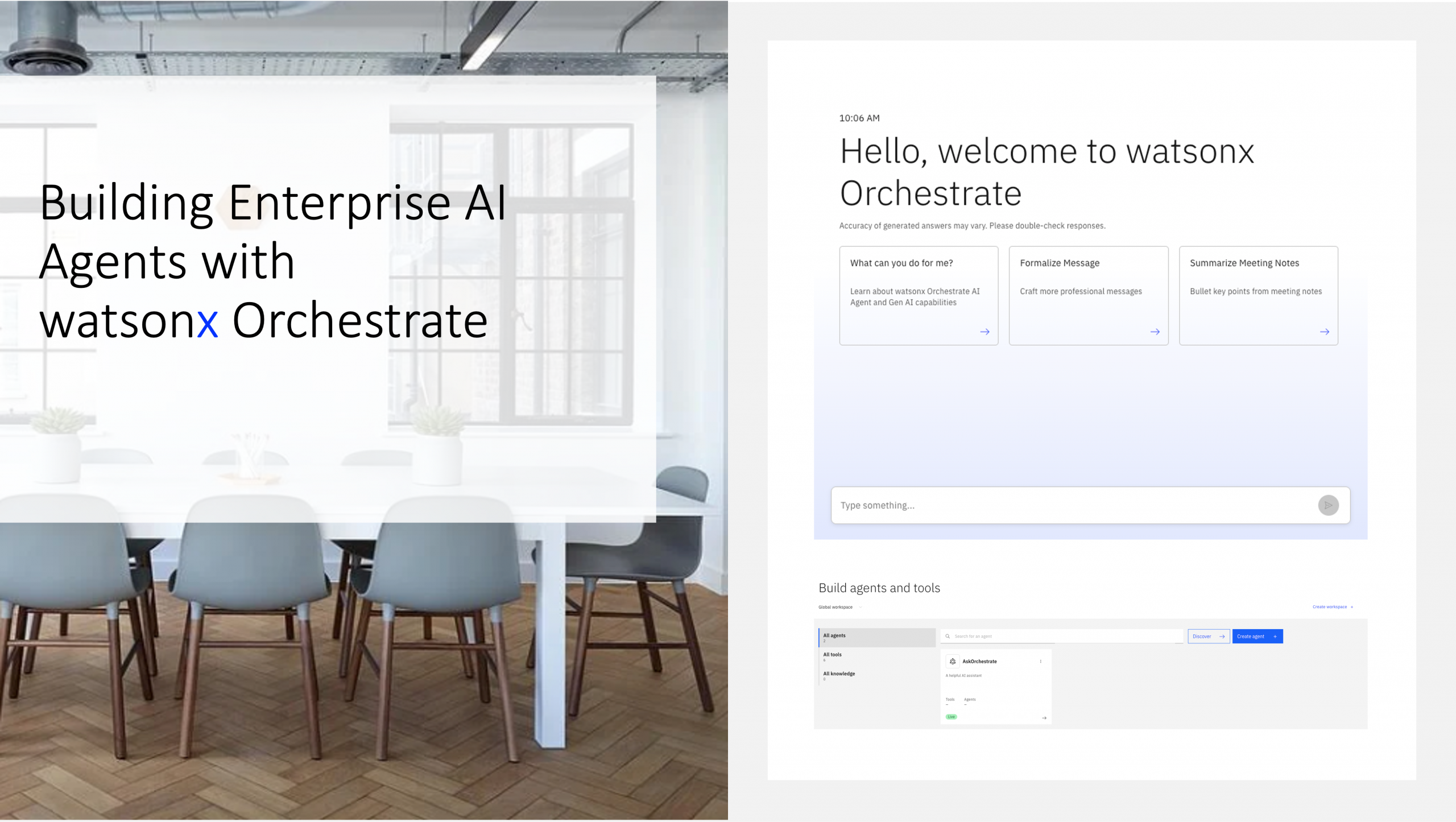
As companies move toward autonomous and agentic AI systems, IBM’s watsonx Orchestrate is becoming an important platform for building, connecting, and managing enterprise AI agents.
watsonx Orchestrate is IBM’s platform for developing AI agents that can reason, use tools, interact with enterprise systems, and automate business processes across an organization. It combines large language models, orchestration capabilities, integrations, governance, and developer tooling into one enterprise-focused platform.
The platform is designed to connect AI agents with real business systems such as HR platforms, CRMs, ticketing systems, databases, APIs, and internal tools. Instead of only generating responses, agents built with watsonx Orchestrate can actively perform tasks and execute workflows.
What is Agentic AI?
Agentic AI describes AI systems that can independently plan and execute actions to achieve a goal.
Instead of following a rigid predefined flow, agents can dynamically decide:
- Which tools to use
- Which systems to query
- What information is needed
- Which next step should be executed
For example, an HR agent could:
- Retrieve employee information
- Create or update records
- Trigger approval processes
- Query payroll systems
- Generate documents
- Send notifications to other systems
all as part of a single orchestrated workflow.
Learn more about how to build agentic ai systems here.
Building Agents and Tools
A central concept in watsonx Orchestrate is the use of tools.
Tools allow agents to interact with external systems and perform actions. These tools can range from very simple integrations to complex enterprise workflows.
Examples include:
- REST APIs
- Database operations
- Python functions
- Internal enterprise services
- Knowledge retrieval systems
- SAP integrations
- Salesforce integrations
- Workflow automation systems
- Multi-step approval flows
Developers can create reusable tools and combine them into larger agentic workflows where agents dynamically determine how tasks should be completed.
This allows organizations to move beyond static automation toward more adaptive AI-driven processes.
Agentic Workflows
One of the powerful aspects of watsonx Orchestrate is orchestration.
Instead of hardcoding every single process path, agents can coordinate multiple actions and systems dynamically.
For example, an onboarding workflow could automatically:
- Create accounts
- Request hardware
- Notify managers
- Schedule training
- Generate access permissions
The agent determines which actions are required and executes them across connected systems.
This makes workflows more flexible and capable of adapting to different situations and business rules.
OpenAPI as Tools
A very practical feature is the ability to import OpenAPI specifications directly into watsonx Orchestrate.
OpenAPI is a standard format for describing REST APIs. Many companies already document their internal services using OpenAPI or Swagger.
watsonx Orchestrate can automatically transform those API endpoints into callable agent tools.
This significantly reduces integration effort because existing backend services – such as FastAPI immediately become available to AI agents.
For example, agents can use APIs for:
- CRM systems
- Inventory management
- Ticketing platforms
- ERP systems
- HR applications
- Internal business services
without developers having to manually rebuild every integration.
MCP Support
watsonx Orchestrate also supports MCP (Model Context Protocol).
MCP is an open standard that defines how AI models and external tools communicate with each other.
Imagine every phone in your house used a completely different charger. One phone uses USB-A, another uses an old Apple Lightning cable, another uses Micro-USB, and another uses a special charger that only works for that single device. That means you constantly need different cables and adapters for everything.
MCP is a bit like USB-C for AI systems.
Instead of every tool or application needing its own completely custom connection, MCP provides one common standard that many systems can use to communicate with AI agents. This makes it much easier for AI agents to connect to different tools, applications, and enterprise systems without developers having to build a brand-new integration every time. Instead of every integration requiring custom logic, MCP provides a consistent structure for exposing tools, resources, and context to AI agents. This helps simplify integrations and allows agents to connect more easily to enterprise environments and external systems.
ADK: Agent Development Kit
For developers, IBM provides the Agent Development Kit (ADK). The ADK is a developer-focused toolkit for building, testing, and deploying agents for watsonx Orchestrate.
Using the ADK, developers can:
- Build agents locally
- Define agents in YAML or JSON
- Create custom Python tools
- Connect APIs and external services
- Test and evaluate workflows
- Deploy agents into enterprise environments
The ADK gives developers full control over the lifecycle of enterprise AI agents while integrating directly with watsonx Orchestrate services and infrastructure.
IBM Using It Internally: AskHR
IBM is also using watsonx Orchestrate internally with its AskHR system.
AskHR is IBM’s internal HR AI platform used by employees worldwide. According to IBM, it automates more than 80 HR-related processes and handles millions of employee interactions every year.
The system integrates with platforms such as Workday, SAP, and Concur to support workflows like:
- Payroll inquiries
- Vacation requests
- Employment verification letters
- Organizational updates
- HR policy assistance
IBM reports that AskHR achieved:
- 94% containment for common HR requests
- More than 11 million employee interactions in 2024
- A 40% reduction in HR operational costs over four years
AskHR is a strong real-world example of how enterprise agentic AI platforms can automate complex internal operations at scale.